
-
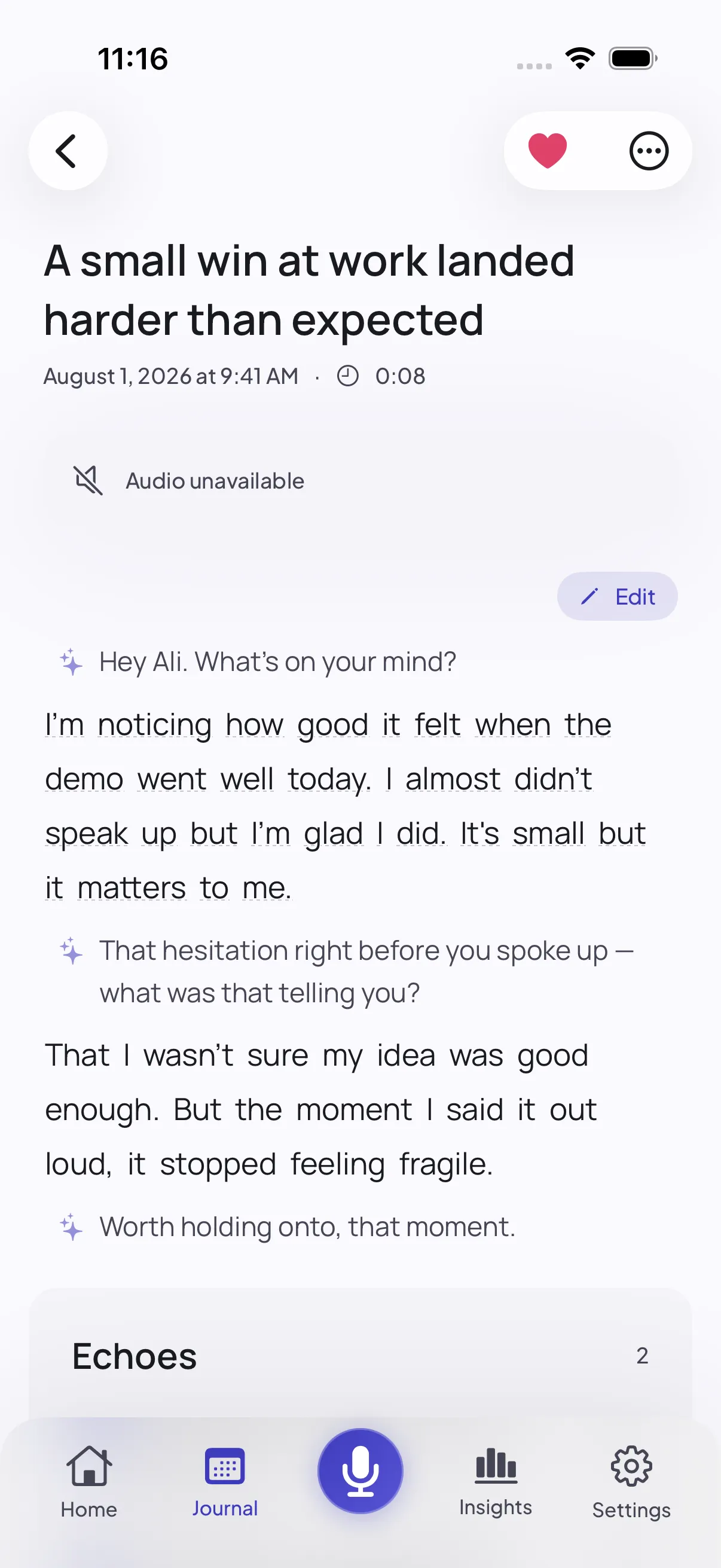
Start with an entry
Anything you’ve already said. A lens is something you reach for afterwards, never part of writing it.
-
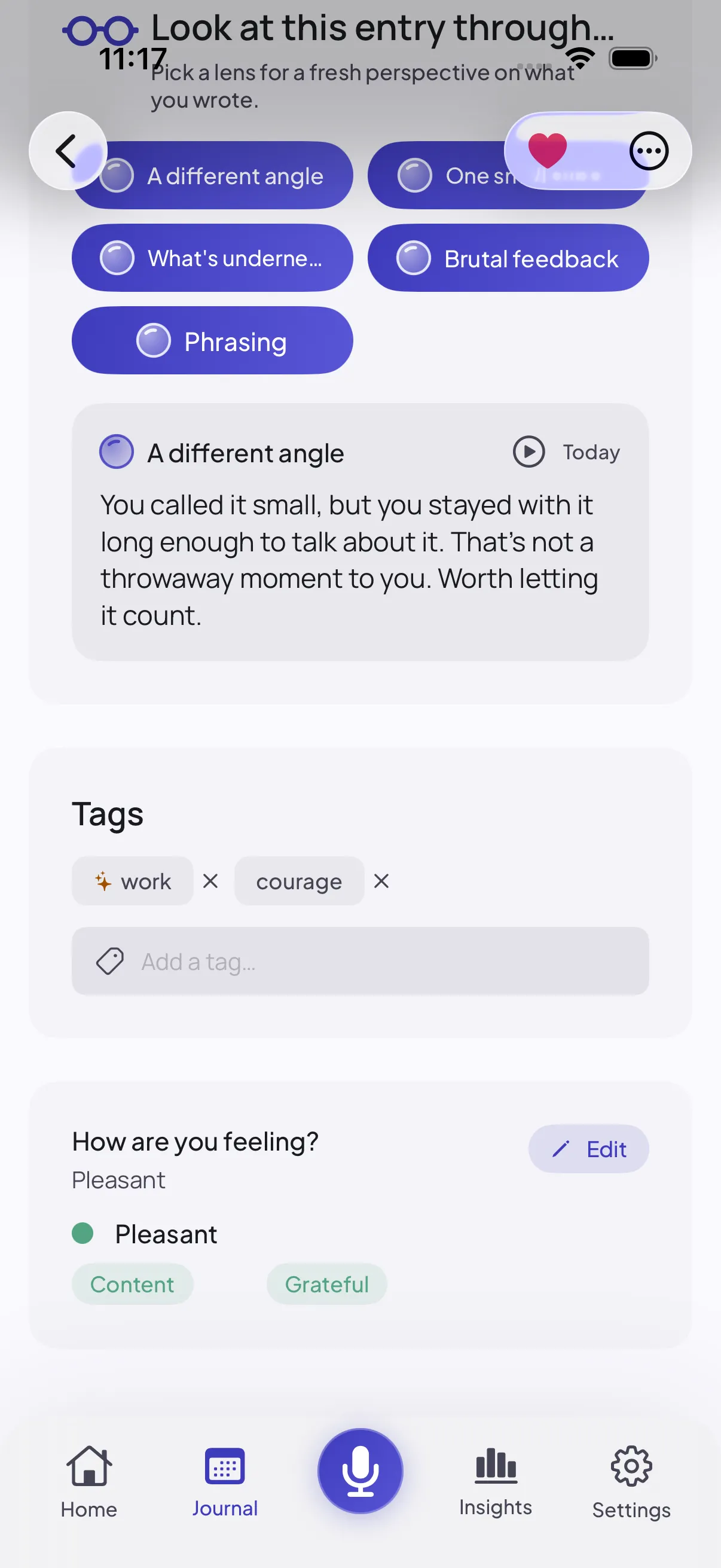
Pick a lens, read the reply
Five ways of asking about the same day, sitting at the bottom of the entry until you tap one — and the answer is filed right there beneath them.
Five questions, one entry
Each is a different thing to ask of the same evening. You can run several, and they don’t have to agree.
-
A different angle
The same events, read from somewhere other than where you were standing when you wrote them down.
-
What’s underneath
The thing below the thing. Often the fear or the wish that the surface complaint was standing in front of.
-
One small experiment
Not a plan and not advice — a single, specific thing worth trying once. The only lens that suggests anything at all.
-
Brutal feedback
The unsoftened version, for when you already know and would rather someone just said it. You have to ask for this one on purpose.
-
Phrasing
What your own wording gives away. Sometimes the sentence you chose is the whole finding.
-
And it can decline
Some entries want to be sat with, not solved. A lens will say so and offer a gentler one rather than manufacture an answer.
The second reading is the useful one
This is the part that’s hard to do for yourself, and easy to refuse when you don’t want it.
-
You already know what you think
That’s the problem. Reading your own entry back gives you the same reading you had while writing it — a lens is the only way to get a second one.
-
Nothing arrives uninvited
No lens ever appears on its own. They wait at the bottom of an entry, and an entry you never open never gets interpreted.
-
Disagreeing is fine
A lens is a reading, not a verdict. Delete one you don’t buy — the entry underneath is untouched, and nothing learns that you rejected it.
A second opinion shouldn’t cost you the entry
Asking for a lens is the one moment an entry’s text leaves the phone — so it’s the moment that gets the most care.
-
The entry stays yours
Your words and recordings live on your iPhone, in storage the system keeps encrypted while your phone is locked.
-
Names never travel
Asking for a lens sends that entry’s text to third-party AI providers — with every name in it, including yours, swapped for a stand-in first.
-
Sensitive entries are out
Mark an entry sensitive and no lens can be run on it. Turn cloud features off and the lens chips stop appearing at all.
Questions about Lenses
What are Lenses?
An optional second look at a single entry: what might be underneath it, a kinder reading of it, or one small experiment worth trying. You ask for a lens — none appear on their own, and you can decline any of them.
Which lenses can I pick from?
A different angle, What’s underneath, One small experiment, Brutal feedback, and Phrasing. Each is a different question asked of the same entry, so the same day can read several ways.
Will a lens tell me what to do?
Only the experiment lens suggests anything, and it’s deliberately one small thing to try — not a plan. The rest offer a reading, and you’re free to disagree with it.
Can a lens refuse?
Yes, and it does. Some entries want to be sat with rather than reframed, and in those cases the lens says so and offers a gentler one instead of forcing an answer.
Do lenses change what I wrote?
Never. A lens is filed alongside the entry as a separate reply. Your words stay exactly as you said them, and you can delete any lens reply without touching the entry.
Be there when it opens
Smart Journaling is in final testing. Leave your email and we’ll send a single note the day it’s live on the App Store — plus a chance to join the beta early. No spam, ever.
Already keen? Join the TestFlight beta →
By joining you agree to receive one launch email. See our privacy policy.